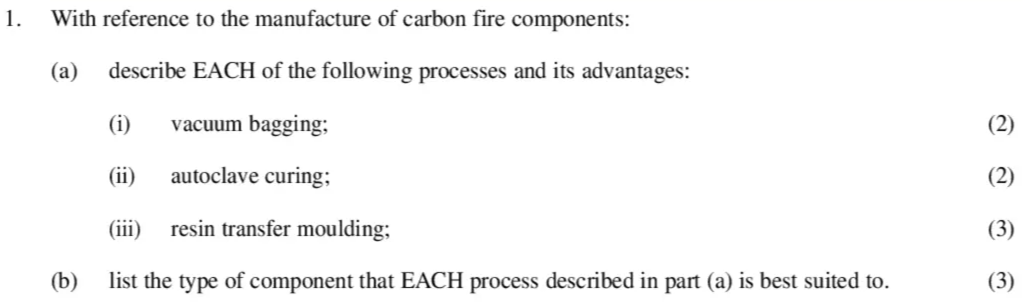
Three different composite fabrication processes: vacuum bagging, autoclave curing, and resin transfer molding (RTM). Each process has its own advantages and disadvantages, and is best suited for different types of components.
Here’s a breakdown of each process:
Vacuum bagging:
Process: A dry fiber preform is placed in a mold, and then covered with a vacuum bag. The air is evacuated from the bag, which applies pressure to the preform and forces the resin to flow through it. The part is then cured under heat.
- Advantages:
- Simple and relatively inexpensive process.
- Can be used with a wide variety of mold materials and shapes.
- Good for producing parts with a high fiber volume fraction.
- Disadvantages:
- Limited to parts with simple geometries.
- Voiding (air pockets) can be an issue.
- Not suitable for high-performance applications.
Autoclave curing:
- Process: The vacuum-bagged part is placed in an autoclave, which is a pressure vessel that can be heated and pressurized. The pressure helps to consolidate the laminate and eliminate voids.
- Advantages:
- Produces high-quality parts with excellent surface finish and low void content.
- Suitable for complex geometries and high-performance applications.
- Disadvantages:
- Expensive process due to the high cost of autoclaves.
- Limited throughput due to the long cycle times.
- Not suitable for large parts.
Resin transfer molding (RTM):
- Process: The dry fiber preform is placed in a closed mold, and then resin is injected into the mold under pressure. The part is then cured under heat.
- Advantages:
- Can produce high-quality parts with good surface finish and low void content.
- Faster cycle times than autoclave curing.
- Can be used for larger parts than vacuum bagging.
- Disadvantages:
- More complex process than vacuum bagging.
- Requires specialized molds and equipment.
- Not suitable for all geometries.
2. With reference to case hardening steel components:(a) Describe the changes that occur with this process:(3 marks)
Case hardening changes the outer surface layer (case) of a low-carbon steel component into a hard, wear-resistant layer, while leaving the core (interior) tough and ductile. The process introduces additional carbon or nitrogen atoms into the surface, increasing hardness through heat treatment. This produces a hard martensitic case after quenching, with the core remaining softer and tough.
(b) Explain why it may be required:(2 marks)
Case hardening is used when a component must resist wear and surface fatigue (e.g. gears, pins, shafts), but still absorb shock loads without cracking. It is often applied to low-carbon steels to combine surface hardness with core toughness, making the part durable and long-lasting.
(c) Describe EACH of the following processes:(i) A simple shipboard process (3 marks)A common shipboard case hardening method is flame hardening. In this process, an oxy-acetylene torch rapidly heats the surface of the component to its critical temperature, after which it is immediately quenched in water or oil. This creates a thin hardened surface. It is quick and suitable for repair work or treating small areas (e.g. bearing surfaces, gear teeth) without requiring a furnace.
(ii) Solid pack carburising (2 marks)Solid pack carburising involves embedding the steel component in a carbon-rich solid compound (like charcoal mixed with barium carbonate) inside a sealed container. The container is heated in a furnace at 900–950°C for several hours. Carbon atoms diffuse into the surface, and the component is then quenched to form a hard martensitic case. It produces deep case depths and is used for components requiring significant surface hardness.