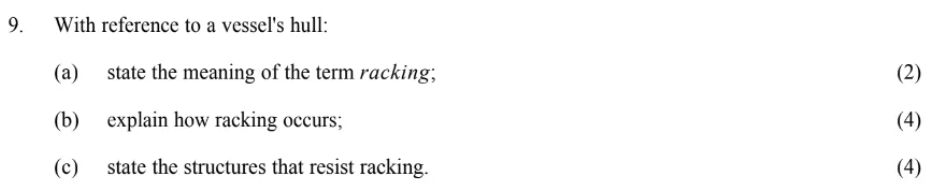
- With reference to a vessel’s hull:
(a) state the meaning of the term racking;(2)
(b) explain how racking occurs;(4)
(c) state the structures that resist racking.(4)
(a) Meaning of the Term Racking (2 marks)
- Racking is the distortion of the ship’s hull in the transverse direction, where the sides of the ship tend to move out of square with the deck and bottom due to external forces.
- It causes the vessel’s transverse shape (normally rectangular) to twist into a parallelogram shape, placing shear stress on bulkheads, frames, and deck beams.
(Definition + nature of distortion = 2 marks)
(b) How Racking Occurs (4 marks)
- Rolling in a seaway – When the vessel rolls, the inertia of the cargo and structure causes alternating side-to-side forces.
- Wave pressure on the sides – As waves strike alternately on the port and starboard sides, unequal water pressures develop across the beam.
- The combination of inertia and wave impact makes the upper deck move sideways relative to the bottom structure.
- This sideward movement results in shear stresses at the connections between frames, deck beams, and shell plating, tending to distort the hull transversely.
(4 clear points explaining mechanism = 4 marks)
(c) Structures That Resist Racking (4 marks)
The ship’s transverse framing system is designed to resist racking stresses and includes:
- Transverse bulkheads – act as rigid diaphragms, preventing the hull from twisting out of shape.
- Deep web frames and beam knees – strengthen the connection between deck beams and side frames, increasing rigidity.
- Deck plating and stringers – form a horizontal girder, resisting shear deformation between sides.
- Corner brackets and floors – tie the bottom, sides, and deck together, helping the hull maintain its box shape.
(1 mark for each correctly identified structure and function = 4 marks)