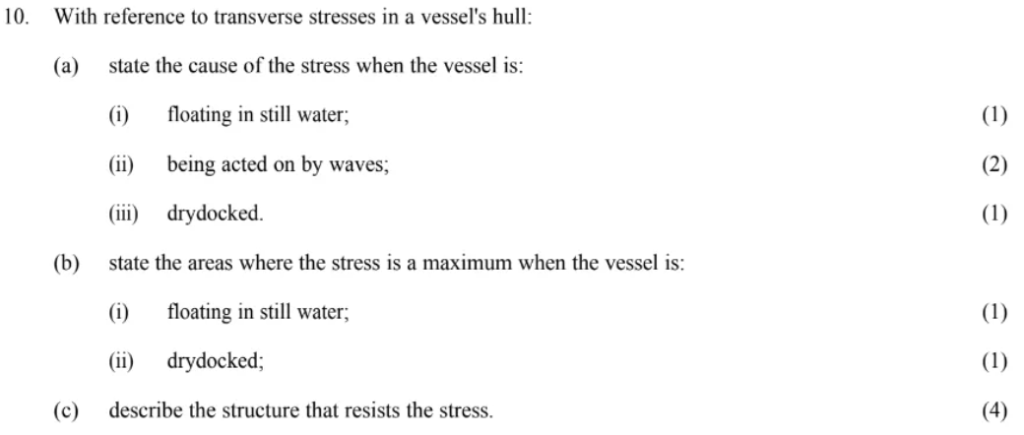
- With reference to transverse stresses in a vessel’s hull:
(a) state the cause of the stress when the vessel is:
(i) floating in still water;(1)
(ii) being acted on by waves;(2)
(iii) drydocked.(1)
(b) state the areas where the stress is a maximum when the vessel is:
(i) floating in still water;(1)
(ii) drydocked;(1)
(c) describe the structure that resists the stress.(4)
(a) Causes of Transverse Stress
(i) Floating in still water (1 mark)
- The vessel’s own weight acts vertically downward, while buoyancy acts upward, causing a uniform transverse bending stress across the hull.
- The main cause is unequal distribution of buoyancy and weight across the vessel’s breadth.
(ii) Being acted on by waves (2 marks)
- When waves strike the side or underside of the vessel, they cause periodic variations in pressure across the beam.
- The hull alternately bends and twists, producing racking stresses (distortion of transverse frames and bulkheads).
- The vessel experiences transverse bending and torsional stresses as the wave crests lift one side or corner of the ship.
(iii) Drydocked (1 mark)
- The keel blocks support the vessel’s weight along the centreline, while there is no buoyancy support at the sides.
- This causes the bottom plating and floors to experience compressive stresses, and the sides to tend to sag outward, producing transverse bending.
(b) Areas of Maximum Stress
(i) Floating in still water (1 mark)
- Maximum transverse stress occurs at the deck and bottom plating, where tensile and compressive stresses are greatest.
(ii) Drydocked (1 mark)
- Maximum stress occurs at the bottom shell plating and bilge areas, near the points where the hull is supported by the keel blocks.
(c) Structure Resisting Transverse Stress (4 marks)
The vessel’s transverse framing system resists these stresses, consisting of:
- Frames (or ribs): Provide the main transverse strength to resist bending and distortion.
- Floors and side frames: Connect the port and starboard sides through the bottom, resisting racking and providing rigidity.
- Beams and deck girders: Support deck plating and resist tensile stresses at the upper part of the hull.
- Transverse bulkheads: Stiffen the hull and prevent distortion by dividing it into watertight sections.