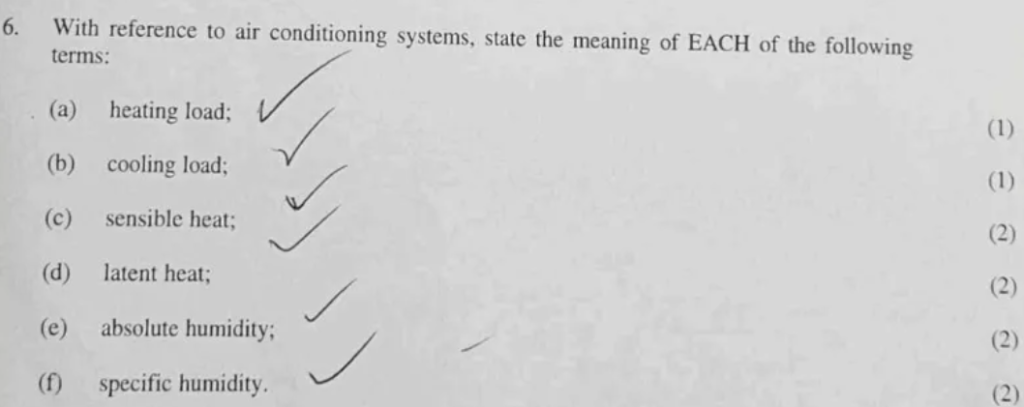
- With reference to air conditioning systems, state the meaning of EACH of the following terms:
(a) heating load;(1)
(b) cooling load;(1)
(c) sensible heat;(2)
(d) latent heat;(2)
(e) absolute humidity;(2)
(f) specific humidity.(2)
(a) Heating load (1)
The heating load is the amount of heat energy that must be supplied to a space to maintain the desired indoor temperature when the outside temperature is lower than the indoor temperature.
(b) Cooling load (1)
The cooling load is the amount of heat energy that must be removed from a space to maintain the desired indoor temperature when the outside or internal heat gains raise the temperature above the comfort level.
(c) Sensible heat (2)
Sensible heat is the heat that causes a change in temperature of a substance without a change in its physical state.
In air conditioning, it is the portion of heat that changes the temperature of the air but not its moisture content.
(d) Latent heat (2)
Latent heat is the heat absorbed or released during a change of state (e.g., water vapour condensing to liquid water) without a change in temperature.
In air conditioning, it is associated with the addition or removal of moisture from the air.
(e) Absolute humidity (2)
Absolute humidity is the actual mass of water vapour present in a unit volume of air, usually expressed in grams of water vapour per cubic metre of air (g/m³).
(f) Specific humidity (2)
Specific humidity is the ratio of the mass of water vapour to the total mass of the air (dry air plus water vapour), usually expressed in grams of water vapour per kilogram of moist air (g/kg).