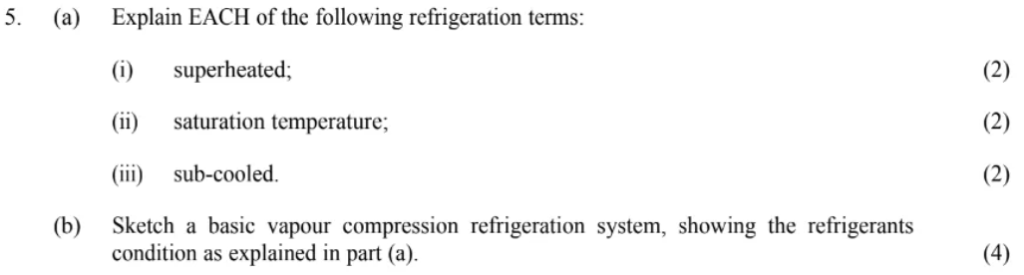
- (a) Explain EACH of the following refrigeration terms:
(i) superheated;
(ii) saturation temperature;
(iii) sub-cooled.
(b) Sketch a basic vapour compression refrigeration system, showing the refrigerants condition as explained in part (a).
(a) Refrigeration Terms
(i) Superheated
- Refers to refrigerant vapour that has been heated above its saturation temperature at a given pressure.
- Example: After leaving the evaporator, vapour may be heated further to ensure no liquid droplets return to the compressor.
- Purpose: Prevents compressor damage and improves efficiency.
(ii) Saturation Temperature
- The temperature at which a liquid refrigerant boils or condenses at a specific pressure.
- At this point, liquid and vapour co-exist in equilibrium.
- Example: In the evaporator, the refrigerant absorbs heat at its saturation temperature while changing phase.
(iii) Sub-cooled
- Refers to liquid refrigerant cooled below its saturation temperature at a given pressure.
- Example: After leaving the condenser, refrigerant is sub-cooled to avoid flash gas formation before the expansion valve.
- Purpose: Improves efficiency and ensures proper expansion valve operation.
(b) Basic Vapour Compression Refrigeration System
The four main components:
- Compressor
- Draws in low-pressure superheated vapour from the evaporator.
- Compresses it to high-pressure, high-temperature superheated vapour.
- Condenser
- Vapour rejects heat to cooling water/air.
- First cools to saturation temperature, condenses to liquid, then further cooled as sub-cooled liquid.
- Expansion Valve (TXV or throttling device)
- Reduces pressure suddenly.
- Sub-cooled liquid partially flashes into vapour and becomes a low-temperature mixture at saturation temperature.
- Evaporator
- The refrigerant absorbs heat from the cooled space.
- At constant pressure, liquid evaporates at its saturation temperature, producing low-pressure vapour.
- Vapour leaving is made slightly superheated before returning to the compressor.
Refrigerant Condition Summary (linked to part a):
- Compressor suction → Superheated vapour
- Compressor discharge → High pressure, superheated vapour
- Condenser outlet → Sub-cooled liquid
- Expansion valve outlet → Saturated mixture (liquid + vapour)
- Evaporator outlet → Low pressure, superheated vapour