
3.
(a) Sketch the relationship between true power (kW), apparent power (kVA), reactive power (kVAr) and power factor (coso) in a.c. electrical generation.(4)
(b) Explain how true power (kW) and reactive power (kVAr) is shared between two generators connected in parallel.(4)
(c) State how kW and kVAr load sharing stability is achieved.(2)
(a) Relationship between true power, apparent power, reactive power, and power factor (4 marks)
- In an a.c. system, apparent power (S) is the vector sum of true power (P) and reactive power (Q):
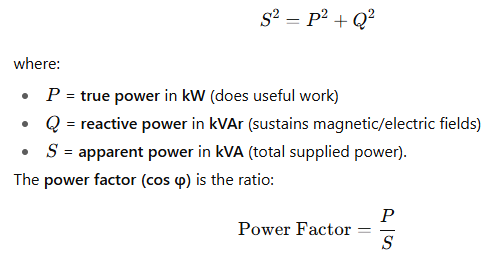
- Thus, power factor expresses the proportion of apparent power converted into useful work.
(b) Sharing of kW and kVAr between two generators in parallel (4 marks)
- kW sharing (true power):
- Controlled by the governor speed/load settings.
- The generator with the lower governor setting (droop) will take less kW, while the one with higher setting will take more.
- Equal adjustment of governors ensures proportional kW load sharing.
- kVAr sharing (reactive power):
- Controlled by the excitation/voltage regulator.
- The generator with higher excitation will supply more reactive power (kVAr).
- By adjusting excitation systems, reactive load is shared proportionally, maintaining busbar voltage.
(c) How kW and kVAr load sharing stability is achieved (2 marks)
- kW stability is maintained by governor droop characteristics, which prevent power oscillations between machines.
- kVAr stability is maintained by voltage regulator droop characteristics, ensuring reactive load is shared proportionally without circulating reactive currents.