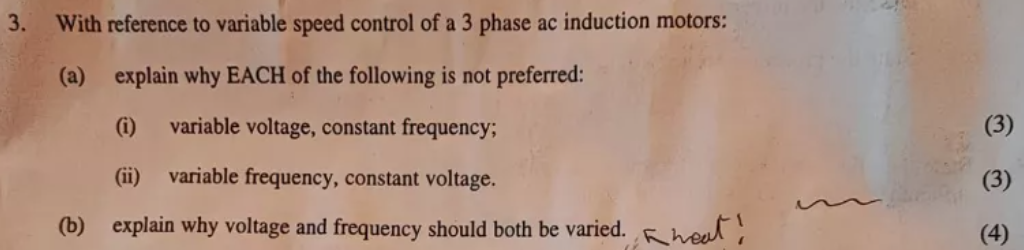
- With reference to variable speed control of a 3 phase ac induction motors:
(a) explain why EACH of the following is not preferred:
(i) variable voltage, constant frequency;(3)
(ii) variable frequency, constant voltage.(3)
(b) explain why voltage and frequency should both be varied. (4)
(a) Why each method is not preferred
(i) Variable voltage, constant frequency (3 marks)
- At constant frequency, the synchronous speed remains the same, so reducing voltage only reduces the torque capability of the motor.
- The motor will run inefficiently with poor torque at low voltages, leading to excessive slip, overheating, and possible stalling under load.
- Therefore, this method is unsuitable for effective variable speed control, as speed remains nearly constant but performance deteriorates.
(ii) Variable frequency, constant voltage (3 marks)
- Reducing frequency without reducing voltage causes the V/f ratio (volts per hertz) to rise.
- A higher V/f ratio increases the magnetic flux in the motor, risking core saturation, overheating, and high magnetising current.
- At higher frequencies, the reduced V/f ratio would weaken the flux, leading to poor torque output.
- Thus, this method results in unstable and unsafe motor operation.
(b) Why voltage and frequency should both be varied (4 marks)
- To maintain constant flux density in the motor, the ratio of voltage to frequency (V/f) must be kept approximately constant.
- Varying both ensures the motor can produce its rated torque across a wide speed range without overheating or saturating.
- This method (known as V/f control) provides smooth and efficient speed control.
- It also preserves motor efficiency, protects insulation, and gives stable torque and power output at different speeds.