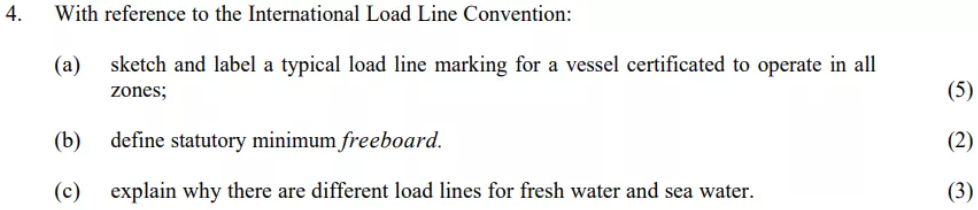
- With reference to the International Load Line Convention:
(a) sketch and label a typical load line marking for a vessel certificated to operate in all zones;(5)
(b) define statutory minimum freeboard.(2)
(c) explain why there are different load lines for fresh water and sea water.(3)
(a) Sketch and label a typical load line marking (5)
A vessel certificated to operate in all zones will carry the Plimsoll Mark and load line grid. Labels must include:
- Deck Line (horizontal line marked amidships at deck edge).
- Plimsoll Circle with horizontal line through centre (the international load line mark).
- Load line marks alongside the circle, indicating the maximum draughts permitted:
- TF – Tropical Fresh Water
- F – Fresh Water
- T – Tropical Seawater
- S – Summer Seawater
- W – Winter Seawater
- WNA – Winter North Atlantic (where applicable).
(In exam: draw circle with horizontal line, then a vertical grid of marks with the above labels.)
(b) Statutory minimum freeboard (2)
- The minimum vertical distance between the freeboard deck and the load line (summer load line) at the ship’s side amidships.
- This ensures sufficient reserve buoyancy and compliance with safety requirements under the Load Line Convention.
(c) Why different load lines for fresh water and sea water (3)
- Density difference: Fresh water is less dense (1.0 t/m³) than sea water (approx. 1.025 t/m³).
- A ship in fresh water sinks deeper for the same displacement than in sea water.
- Therefore, a greater freeboard must be allowed in fresh water to ensure equivalent buoyancy and safety.