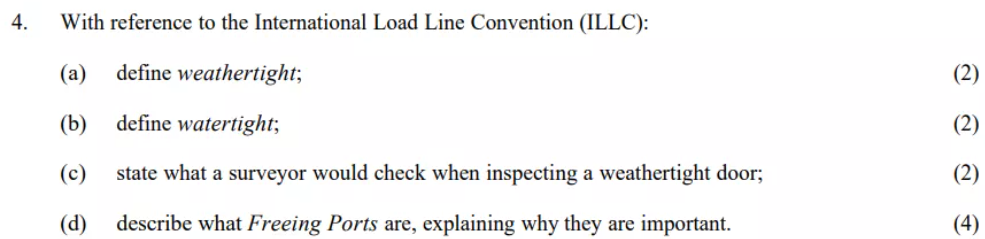
- With reference to the International Load Line Convention (ILLC):
(a) define weathertight;(2)
(b) define watertight;(2)
(c) state what a surveyor would check when inspecting a weathertight door;(2)
(d) describe what Freeing Ports are, explaining why they are important.(4)
(a) Define weathertight (2)
- Weathertight means that in any sea conditions, water will not penetrate into the ship through the fitting (doors, hatches, ventilators, etc.).
- The fitting can withstand the force of sea spray, green water, and weather without leakage into the space protected.
(b) Define watertight (2)
- Watertight means that water will not pass in either direction through the fitting under a head of water.
- Watertight boundaries are capable of resisting full hydrostatic pressure from either side (e.g. bulkheads, watertight doors, tank boundaries).
(c) Surveyor’s checks on a weathertight door (2)
When inspecting a weathertight door, a surveyor would check:
- Condition of gaskets and sealing surfaces – no cracks, compression, or deterioration.
- Operation of securing/closing devices (dogs/handles) – ensuring they close properly and evenly all around.
(Other valid points: hinges intact, no corrosion, correct alignment, no leakage on hose test.)
(d) Freeing Ports – description and importance (4)
- Definition: Freeing ports are openings in the bulwarks on exposed decks fitted with flaps or bars, designed to allow shipped water to drain quickly overboard.
- Importance:
- Prevents accumulation of water on deck which could lead to loss of stability due to free surface effect.
- Reduces additional weight and stress on the deck and hull.
- Ensures the ship’s deck remains clear for safe working and reduces risk of structural damage.