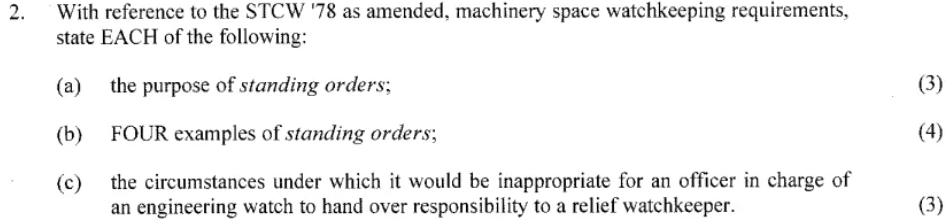
- With reference to the STCW ’78 as amended, machinery space watchkeeping requirements, state EACH of the following:
(a) the purpose of standing orders,(3)
(b) FOUR examples of standing orders,(4)
(c) the circumstances under which it would be inappropriate for an officer in charge of an engineering watch to hand over responsibility to a relief watchkeeper.(3)
(a) Purpose of standing orders (3)
Standing orders:
- Provide written instructions from the Chief Engineer to guide the Officer in Charge of the Engineering Watch (OICEW).
- Ensure standardisation and continuity of safe watchkeeping practices.
- Highlight special instructions or machinery limitations specific to the voyage, vessel, or machinery condition.
(b) Four examples of standing orders (4)
- Instructions for response to alarms (e.g. high temperature, low pressure, fire, bilge).
- Procedures for reporting to the Chief Engineer in abnormal or emergency situations.
- Requirements for machinery log entries and monitoring (pressures, temperatures, sump levels).
- Orders regarding machinery readiness for manoeuvring in restricted waters or heavy traffic.
(Other valid examples: bilge/ballast operations, fuel transfers, security of unmanned machinery spaces.)
(c) Circumstances when it is inappropriate to hand over watch (3)
The OICEW must not hand over responsibility if:
- The relief watchkeeper is not fit for duty (e.g. fatigued, impaired, or unfamiliar with conditions).
- The machinery space is in an abnormal or emergency condition (e.g. fire, flooding, serious breakdown).
- The relief officer is not fully briefed on the status of machinery, ongoing operations, or standing orders.