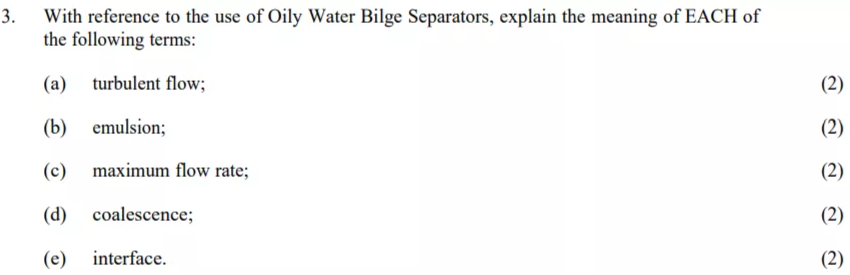
- With reference to the use of Oily Water Bilge Separators, explain the meaning of EACH of the following terms:
(a) turbulent flow;(2)
(b) emulsion;(2)
(c) maximum flow rate;(2)
(d) coalescence;(2)
(e) interface.(2)
(a) Turbulent Flow (2 marks)
- Meaning: A flow regime where the liquid moves in irregular, chaotic patterns with mixing and eddies rather than smooth layers.
- Relevance to OWS: Turbulence prevents oil droplets from rising and separating efficiently, so OWS design seeks to minimise turbulence.
(b) Emulsion (2 marks)
- Meaning: A stable mixture of oil and water where fine droplets of one are suspended within the other.
- Relevance to OWS: Detergents and agitation create emulsions, which make oil–water separation difficult and reduce separator efficiency.
(c) Maximum Flow Rate (2 marks)
- Meaning: The highest flow of bilge water the OWS is designed to treat effectively while still meeting MARPOL’s 15 ppm discharge standard.
- Relevance to OWS: If exceeded, separation efficiency drops, risking illegal overboard discharge.
(d) Coalescence (2 marks)
- Meaning: The process where small oil droplets merge to form larger droplets.
- Relevance to OWS: Larger droplets rise more quickly and separate more easily, so coalescer packs are fitted to promote coalescence.
(e) Interface (2 marks)
Relevance to OWS: The interface must be controlled to ensure clean water is drawn off below oil layer, preventing contamination of discharge.
Meaning: The boundary layer between two immiscible liquids, e.g. oil and water.