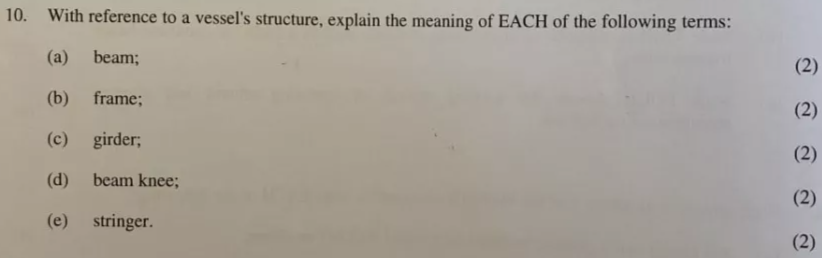
With reference to a vessel’s structure, explain the meaning of EACH of the following terms: (a) beam;(2) (b) frame;(2) (c) girder,(2) (d) beam knee;(2) (e) stringer.(2)
(a) Beam (2 marks)
The greatest breadth (width) of the ship measured at its widest point.
In structural terms, a beam is also a transverse member of the deck structure, running from side to side to support the deck plating and distribute loads to the ship’s frames.
(b) Frame (2 marks)
The transverse structural ribs of the ship’s hull that extend outward from the keel up the ship’s sides.
They provide the vessel with shape and strength, resisting external water pressure and maintaining hull integrity.
(c) Girder (2 marks)
A longitudinal strength member running fore and aft, usually deeper than beams, supporting the deck, bottom, or bulkhead plating.
Main girders (e.g. keelson, deck girders) are essential for the vessel’s longitudinal strength.
(d) Beam Knee (2 marks)
A triangular bracket fitted between the end of a deck beam and the ship’s frame or shell plating.
Provides extra strength at the joint, stiffening the connection and helping resist stresses from deck loads and hull movement.
(e) Stringer (2 marks)
A longitudinal strength member running along the inside of the ship’s hull, fitted at the deck, bilge, or other levels.
Acts as a continuous stiffener, tying frames together and increasing the hull’s longitudinal rigidity.