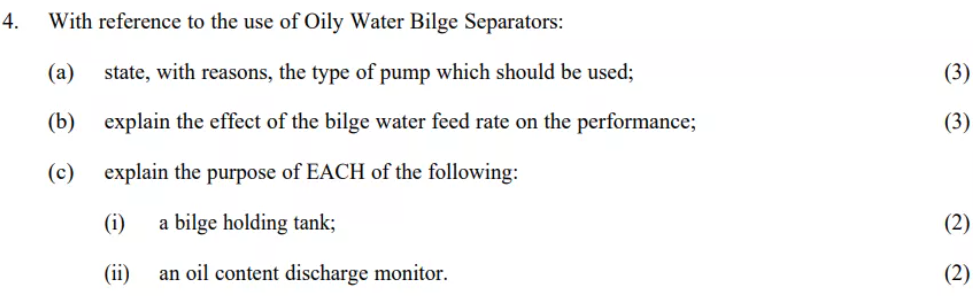
- With reference to the use of Oily Water Bilge Separators:
(a) state, with reasons, the type of pump which should be used;(3)
(b) explain the effect of the bilge water feed rate on the performance;(3)
(c) explain the purpose of EACH of the following:
(i) a bilge holding tank;(2)
(ii) an oil content discharge monitor.(2)
(a) Type of pump to be used, with reasons (3 marks)
- Pump type: Positive displacement pump (e.g., screw or gear pump).
- Reasons:
- Provides a steady, non-pulsating flow.
- Flow rate can be accurately controlled, which is vital for efficient separation.
- Unlike centrifugal pumps, the discharge rate is not significantly affected by variations in back pressure.
(b) Effect of bilge water feed rate on performance (3 marks)
- If feed rate is too high:
- The oil/water mixture passes through the separator too quickly.
- Oil droplets do not have time to separate, leading to poor efficiency and oil discharge above the 15 ppm limit.
- If feed rate is controlled/steady:
- Separation is more efficient.
- The OWS operates as designed and complies with MARPOL requirements.
(c) Purpose of specific components
(i) Bilge holding tank (2 marks):
- Provides temporary storage of bilge water before treatment.
- Allows controlled pumping to the OWS at a steady rate, improving separation and ensuring compliance.
(ii) Oil content discharge monitor (2 marks):
- Continuously measures the oil concentration in the effluent leaving the OWS.
- Ensures overboard discharge only occurs when oil content ≤ 15 ppm; otherwise, alarms sound and discharge is automatically stopped or diverted.