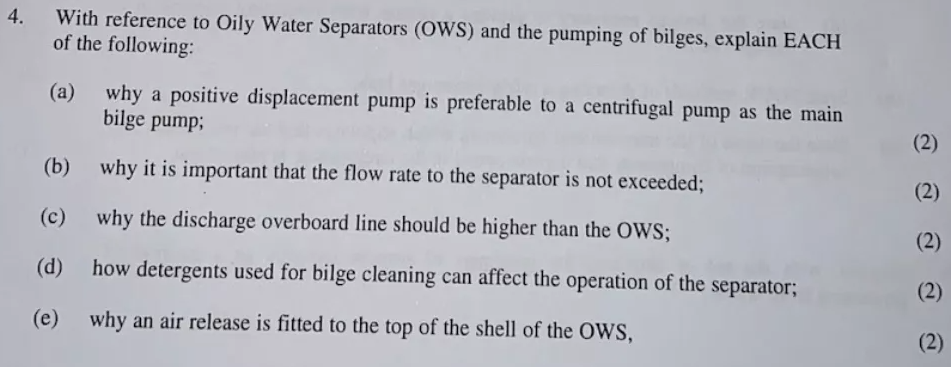
- With reference to Oily Water Separators (OWS) and the pumping of bilges, explain EACH of the following:
(a) why a positive displacement pump is preferable to a centrifugal pump as the main bilge pump;(2)
(b) why it is important that the flow rate to the separator is not exceeded;(2)
(c) why the discharge overboard line should be higher than the OWS;
(2)
(d) how detergents used for bilge cleaning can affect the operation of the separator;(2)
(e) why an air release is fitted to the top of the shell of the OWS,(2)
(a) Why a positive displacement pump is preferable to a centrifugal pump as the main bilge pump (2 marks)
- A positive displacement pump delivers a constant, non-varying flow regardless of discharge head or pressure changes.
- A centrifugal pump output fluctuates with back pressure and may lose suction if air or vapour enters the bilge line.
(b) Why it is important that the flow rate to the separator is not exceeded (2 marks)
- The OWS is designed to operate at a specific flow rate for effective oil-water separation.
- Excessive flow causes turbulence and carryover of oil, leading to oil content exceeding 15 ppm and potential MARPOL violations.
(c) Why the discharge overboard line should be higher than the OWS (2 marks)
- Prevents backflow of seawater into the separator when not operating.
- Ensures gravity-assisted drainage and maintains correct separation pressure balance.
(d) How detergents used for bilge cleaning can affect the operation of the separator (2 marks)
- Detergents form stable oil-in-water emulsions which are difficult to separate.
- This reduces separator efficiency, leading to excess oil in effluent and possible environmental non-compliance.
(e) Why an air release is fitted to the top of the shell of the OWS (2 marks)
- Removes trapped air pockets that would reduce effective liquid volume and disrupt separation.
- Prevents air lock and pressure build-up, ensuring smooth flow through the separator.
✅ Marking Scheme (10 marks total):
- (a) 2 marks (constant flow + avoids loss of suction)
- (b) 2 marks (design flow rate + turbulence/carryover risk)
- (c) 2 marks (backflow prevention + drainage balance)
- (d) 2 marks (emulsions + reduced efficiency)
- (e) 2 marks (air pockets + smooth flow)