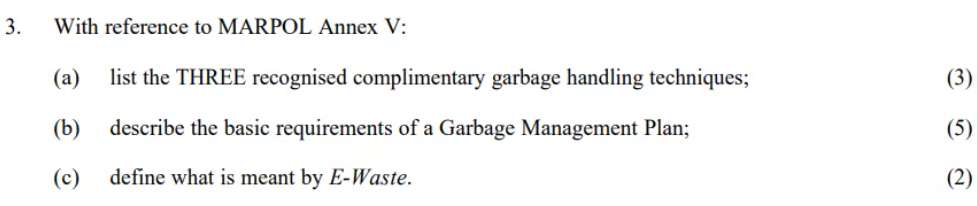
- With reference to MARPOL Annex V:
(a) list the THREE recognised complimentary garbage handling techniques;(3)
(b) describe the basic requirements of a Garbage Management Plan;(5)
(c) define what is meant by E-Waste.(2)
(a) Three recognised complementary garbage handling techniques (3 marks)
- Avoidance / Minimisation at source – reduce the amount of garbage generated onboard through careful purchasing and storage practices.
- Reuse / Recycling – segregate suitable waste streams (e.g., paper, plastics, metals, glass) for recycling ashore.
- Disposal – proper onboard treatment (e.g., incineration) or disposal in accordance with MARPOL Annex V discharge criteria.
(b) Basic requirements of a Garbage Management Plan (5 marks)
The Garbage Management Plan (GMP) must:
- Provide procedures for collecting, storing, processing, and disposing of garbage.
- Identify the person responsible for carrying out the plan (usually the Master or a designated officer).
- Include procedures for minimising garbage and promoting recycling where possible.
- Detail methods for segregation of different garbage categories as per Annex V.
- Be written in the working language of the crew and available for inspection by Port State Control.
(c) Definition of E-Waste (2 marks)
- E-Waste (Electronic Waste) refers to discarded electrical and electronic equipment such as computers, printers, batteries, fluorescent tubes, and circuit boards.
- It is considered hazardous due to the presence of toxic substances (e.g., lead, mercury, cadmium) and requires special handling and disposal ashore.