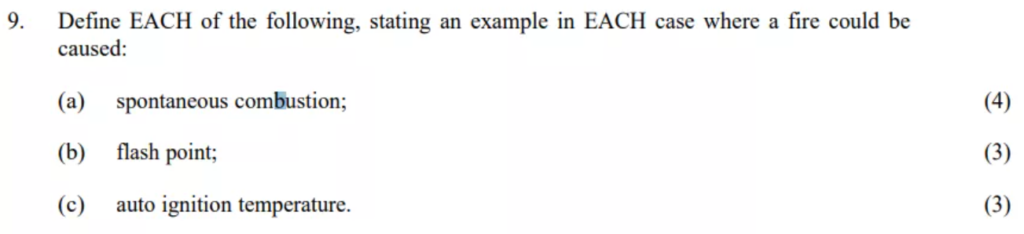
Define EACH of the following, stating an example in EACH case where a fire could be caused: (a) spontaneous combustion; (4) (b) flash point; (3) (c) auto ignition temperature. (3)
(a) Spontaneous Combustion (4 marks)
Definition: The ignition of a material without any external flame or spark, caused by internal heat build-up from chemical or biological processes until ignition temperature is reached.
Example: Oily rags left in an enclosed space (engine room bilges or workshop stores) can heat up and self-ignite.
(b) Flash Point (3 marks)
Definition: The lowest temperature at which a liquid gives off sufficient vapour to form a flammable mixture with air that will ignite when exposed to a flame or spark.
Example: Diesel oil has a flash point around 60 °C; a spillage on a hot surface can ignite.
(c) Auto-Ignition Temperature (3 marks)
Definition: The lowest temperature at which a substance will ignite spontaneously in air without any external flame or spark.
Example: Fuel oil sprayed onto a hot engine exhaust manifold can ignite when the surface temperature exceeds its auto-ignition temperature (~250–300 °C).