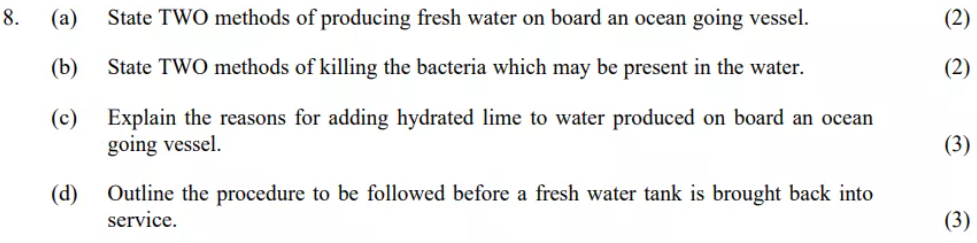
8.(a) State TWO methods of producing fresh water on board an ocean going vessel.(2)
(b) State TWO methods of killing the bacteria which may be present in the water.(2)
(c) Explain the reasons for adding hydrated lime to water produced on board an ocean going vessel.(3)
(d) Outline the procedure to be followed before a fresh water tank is brought back into service.(3)
(a) Methods of producing fresh water on board (2 marks)
- Evaporation/Distillation plant – uses waste heat from main engine jacket cooling water or steam to evaporate seawater, which is then condensed into fresh water.
- Reverse Osmosis (RO) plant – uses semi-permeable membranes and high pressure to separate fresh water from seawater.
(b) Methods of killing bacteria in water (2 marks)
- Chlorination – dosing the water with chlorine or calcium hypochlorite.
- UV sterilisation or Silver ion dosing – physical or ionic sterilisation methods.
(c) Reasons for adding hydrated lime to water (3 marks)
- Hydrated lime (Ca(OH)₂) is added to:
- Increase alkalinity and adjust the pH to neutral or slightly alkaline (prevents water being corrosive to pipes and tanks).
- Prevent corrosion of storage tanks, piping, and hot water systems.
- Provide a small mineral content to improve the taste of otherwise “flat” distilled or RO water.
(d) Procedure before bringing a fresh water tank back into service (3 marks)
- Drain and clean the tank thoroughly, removing any sludge, scale, or sediment.
- Sterilise/disinfect – wash down with a chlorine solution or other approved disinfectant, then flush.
- Inspect and refill – check coatings/condition, rinse, then refill with treated fresh water and test for quality before connecting to the ship’s supply system.