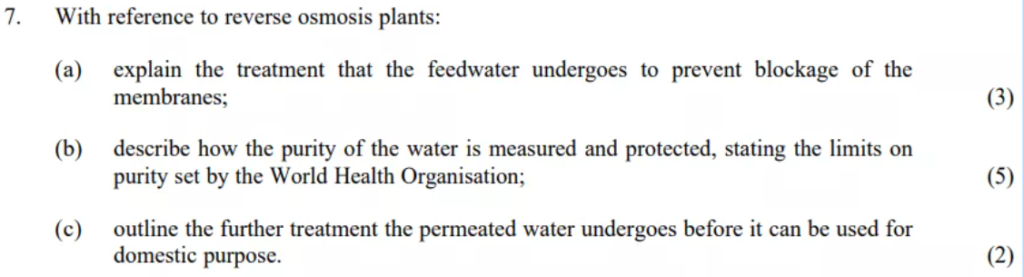
- With reference to reverse osmosis plants:
(a) explain the treatment that the feedwater undergoes to prevent blockage of the membranes;(3)
(b) describe how the purity of the water is measured and protected, stating the limits on purity set by the World Health Organisation;(5)
(c) outline the further treatment the permeated water undergoes before it can be used for domestic purpose.(2)
(a) Feedwater treatment to prevent membrane blockage (3 marks)
Before seawater enters the RO membranes, it must be carefully treated to protect the delicate spirally wound membranes:
- Filtration – coarse strainers, sand/multimedia filters, and fine cartridge filters (≈ 5 µm) remove suspended solids and silt.
- Chemical dosing – antiscalants are added to prevent scale deposits; sodium bisulphite is dosed to neutralise chlorine, which would otherwise damage the membranes.
- Pre-chlorination & de-chlorination – chlorine may first be added to kill bacteria, then neutralised before reaching the membranes.
(b) Purity measurement, protection, and WHO limits (5 marks)
- Measurement:
- A conductivity or Total Dissolved Solids (TDS) meter is fitted on the permeate line.
- Conductivity provides a direct measure of dissolved salts; an alarm trips if salinity rises above limits.
- Protection:
- Automatic control diverts water back to drain/overboard if TDS is too high, preventing contamination of storage tanks.
- WHO limits:
- The World Health Organisation (WHO) standard for potable water is ≤ 500 ppm (mg/L) TDS, though most marine systems operate with a lower internal limit (e.g., ≤ 200–250 ppm) for safety.
- Conductivity equivalent is typically < 1000 µS/cm.
(c) Further treatment of permeate water (2 marks)
Even after desalination, RO permeate is not immediately suitable for domestic use:
- Re-mineralisation – small amounts of minerals (e.g., calcium carbonate) are added to reduce the water’s corrosiveness.
- Disinfection/sterilisation – usually by chlorination, UV treatment, or silver ion dosing to ensure bacteriological safety during storage and distribution.