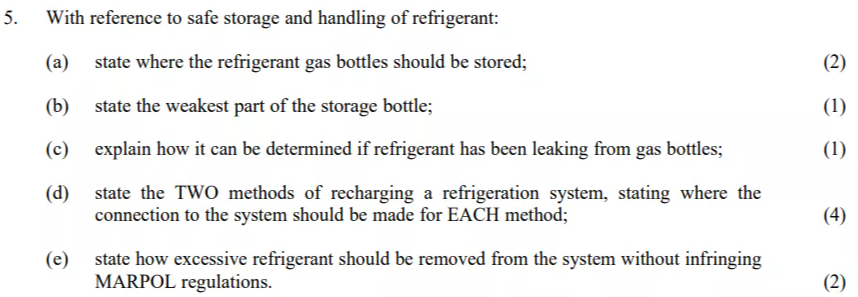
- With reference to safe storage and handling of refrigerant:
(a) state where the refrigerant gas bottles should be stored;(2)
(b) state the weakest part of the storage bottle;(1)
(c) explain how it can be determined if refrigerant has been leaking from gas bottles;(1)
(d) state the TWO methods of recharging a refrigeration system, stating where the connection to the system should be made for EACH method;(4)
(e) state how excessive refrigerant should be removed from the system without infringing MARPOL regulations.(2)
Safe Storage and Handling of Refrigerant
(a) Storage location for refrigerant gas bottles (2 marks)
- Stored in a cool, well-ventilated space on deck.
- Kept away from direct sunlight, heat sources, and accommodation spaces to avoid pressure build-up and safety hazards.
(b) Weakest part of the storage bottle (1 mark)
- The safety relief valve/fusible plug (designed to release gas safely if internal pressure rises excessively).
(c) How to detect if refrigerant is leaking from bottles (1 mark)
- Check for frosting or oil stains around the valve/cap, or use a portable electronic leak detector near the bottle.
(d) Two methods of recharging a refrigeration system (4 marks)
- Charging as a liquid:
- Connection made at the liquid line (downstream of the condenser/receiver, before the expansion valve).
- System must be off or carefully controlled to avoid liquid slugging.
- Charging as a vapour:
- Connection made at the suction side of the compressor (low-pressure side).
- Done slowly while the system is running to draw in refrigerant safely.
(e) Removing excessive refrigerant without infringing MARPOL (2 marks)
- Excess refrigerant must be recovered into approved storage/recovery cylinders using a recovery unit.
- Never vented to atmosphere; cylinders are returned ashore to authorised facilities for safe disposal or recycling.