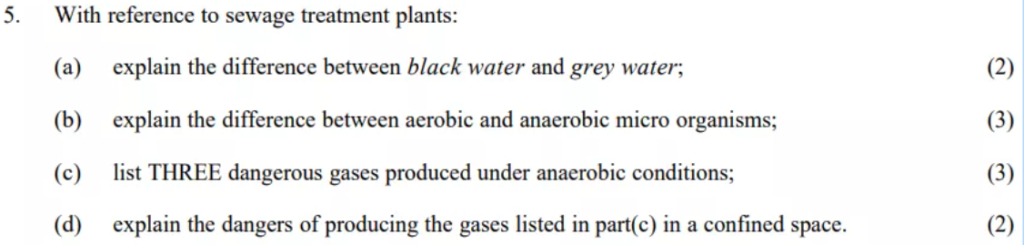
- With reference to sewage treatment plants:
(a) explain the difference between black water and grey water;(2)
(b) explain the difference between aerobic and anaerobic micro organisms;(3)
(c) list THREE dangerous gases produced under anaerobic conditions;(3)
(d) explain the dangers of producing the gases listed in part(c) in a confined space.(2)
Sewage Treatment Plants
(a) Difference between black water and grey water (2 marks)
- Black water: Wastewater from toilets, urinals, and medical facilities — contains human waste and pathogens.
- Grey water: Wastewater from galleys, showers, washbasins, and laundries — contains soaps, grease, and food residues but not human waste.
(b) Difference between aerobic and anaerobic microorganisms (3 marks)
- Aerobic microorganisms: Require oxygen to survive; break down sewage into stable products (CO₂, water, sludge) with minimal odour.
- Anaerobic microorganisms: Survive without oxygen; break down sewage producing harmful by-products (e.g. H₂S, methane).
- Aerobic processes are preferred in marine sewage plants due to efficiency and safety.
(c) Three dangerous gases produced under anaerobic conditions (3 marks)
- Hydrogen sulphide (H₂S).
- Methane (CH₄).
- Carbon dioxide (CO₂).
(d) Dangers of producing these gases in a confined space (2 marks)
- Hydrogen sulphide: Highly toxic even in low concentrations; causes respiratory paralysis.
- Methane and carbon dioxide: Displace oxygen, leading to asphyxiation risk; methane is also highly flammable and explosive.