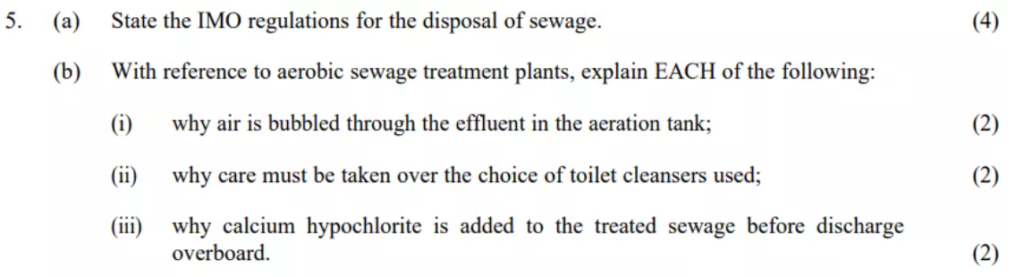
- (a) State the IMO regulations for the disposal of sewage.(4)
(b) With reference to aerobic sewage treatment plants, explain EACH of the following:
(i) why air is bubbled through the effluent in the aeration tank;(2)
(ii) why care must be taken over the choice of toilet cleansers used;(2)
(iii) why calcium hypochlorite is added to the treated sewage before discharge overboard.(2)
(a) IMO Regulations for the Disposal of Sewage (MARPOL Annex IV) (4 marks)
- Untreated sewage may only be discharged 12 nautical miles or more from land, while the ship is en route.
- Comminuted and disinfected sewage may be discharged 3 nautical miles or more from land, while en route.
- Sewage processed through an approved sewage treatment plant may be discharged at any distance from land, provided effluent meets IMO standards.
- Discharge must not cause visible floating solids or discolouration of the surrounding water.
(b) Aerobic Sewage Treatment Plants
(i) Why air is bubbled through the effluent in the aeration tank (2 marks)
- Provides oxygen to sustain aerobic microorganisms that break down organic matter.
- Prevents septic (anaerobic) conditions, which would lead to odour and harmful gas production.
(ii) Why care must be taken over the choice of toilet cleansers (2 marks)
- Strong disinfectants or chemicals may kill aerobic bacteria, disrupting the biological process.
- Only approved, biodegradable cleansers should be used to protect the treatment system.
(iii) Why calcium hypochlorite is added before discharge (2 marks)
- Acts as a disinfectant, killing remaining pathogens in the treated effluent.
- Ensures compliance with MARPOL Annex IV by making discharge safe for the marine environment.