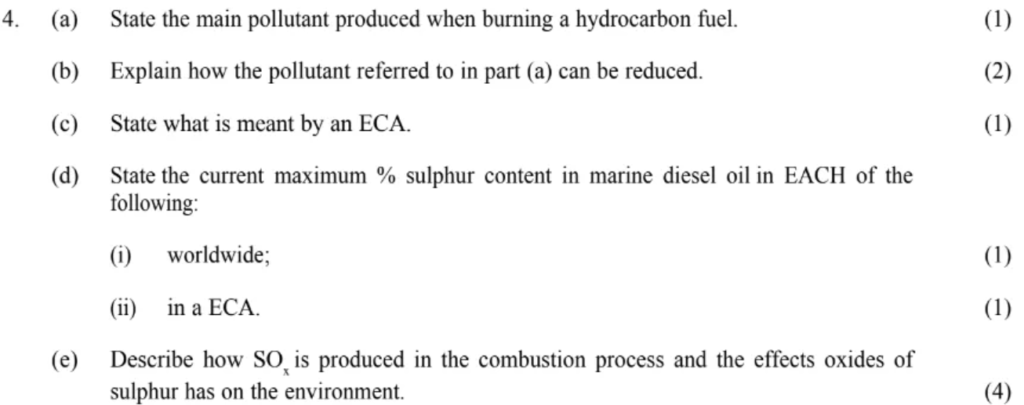
- (a) State the main pollutant produced when burning a hydrocarbon fuel.(1)
(b) Explain how the pollutant referred to in part (a) can be reduced.(2)
(c) State what is meant by an ECA.(1)
(d) State the current maximum % sulphur content in marine diesel oil in EACH of the following:
(i) worldwide;(1)
(ii) in a ECA.(1)
(e) Describe how SO, is produced in the combustion process and the effects oxides of sulphur has on the environment.(4)
Pollution from Hydrocarbon Fuel Combustion
(a) Main pollutant: Sulphur oxides (SOₓ). (1 mark)
(b) Reduction methods (2 marks):
- By using low-sulphur fuel oils or distillates.
- By fitting exhaust gas cleaning systems (scrubbers) to remove SOₓ from emissions.
(c) ECA: Emission Control Area — a designated sea area with stricter controls on ship emissions. (1 mark)
(d) Maximum sulphur content in marine diesel oil:
- (i) Worldwide: 0.50% m/m. (1 mark)
- (ii) In an ECA: 0.10% m/m. (1 mark)
(e) Production of SOₓ and environmental effects (4 marks):
- Produced when sulphur in the fuel combines with oxygen during combustion → SO₂ (and some SO₃).
- In the atmosphere, these oxides combine with water vapour to form sulphuric acid mist, leading to acid rain.
- Acid rain causes damage to vegetation, marine ecosystems, and buildings.
- SOₓ emissions also contribute to respiratory problems and reduced air quality.