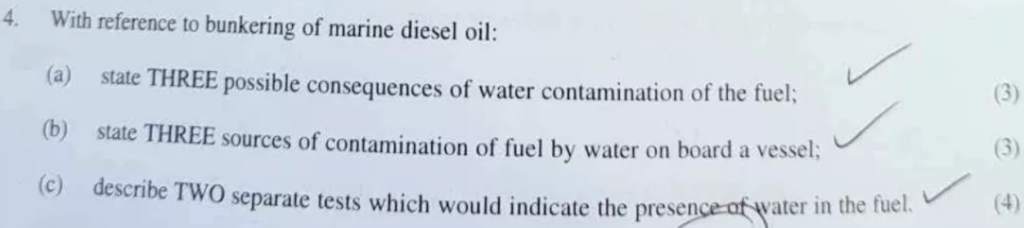
- With reference to bunkering of marine diesel oil:
(a) state THREE possible consequences of water contamination of the fuel;(3)
(b) state THREE sources of contamination of fuel by water on board a vessel;(3)
(c) describe TWO separate tests which would indicate the presence of water in the fuel.(4)
Bunkering of Marine Diesel Oil
(a) Consequences of water contamination (3 marks)
- Poor combustion, leading to loss of power and increased exhaust smoke.
- Damage to fuel pumps and injectors due to corrosion and reduced lubricity.
- Risk of engine failure or rough running if free water reaches the combustion space.
(b) Sources of contamination by water on board (3 marks)
- Leaking bunker tank vent pipes or deck openings allowing rain or sea water ingress.
- Condensation inside storage or service tanks.
- Leaking tank heating coils or cooler tubes.
(c) Tests for presence of water in fuel (4 marks)
- Water detection paste applied to sounding tape – changes colour in contact with water at the tank bottom.
- Centrifuge bottle (clear and bright) test – a fuel sample is allowed to settle and inspected visually for water droplets or cloudiness.
(Alternative accepted answers: distillation test, crackle test on a hot plate, Karl Fischer titration in laboratories.)