

Aux 2 Unit 16 Stress on hull Quiz

4

Aux 2 Unit 16 Q1

1 / 9

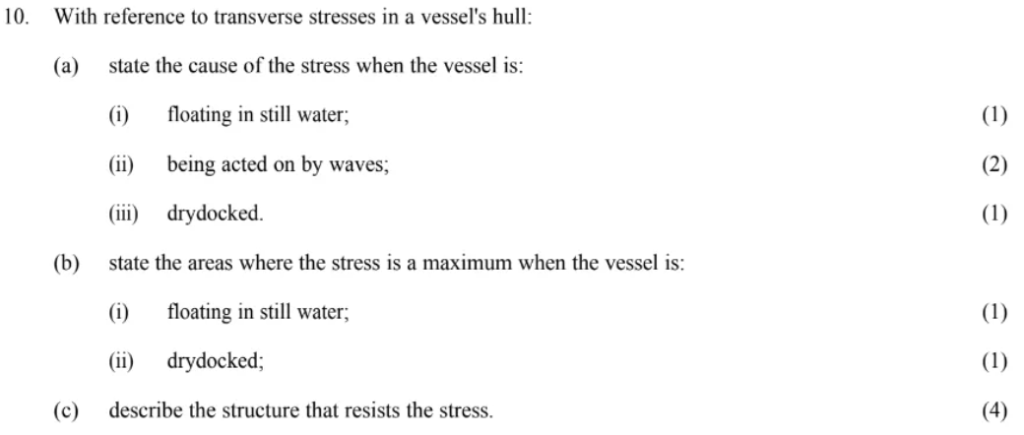
How do longitudinal stringers assist in resisting transverse stresses?

2 / 9

Why are deck beams important in resisting transverse stresses?

3 / 9

What causes transverse stress on a vessel when it is being acted on by waves?

4 / 9

Where is transverse stress at its maximum when a vessel is drydocked?

5 / 9

What is the primary cause of transverse stress when a vessel is floating in still water?

6 / 9

Where is transverse stress typically at its maximum when a vessel is floating in still water?

7 / 9

Which part of the ship helps resist transverse stress by increasing the vessel’s overall rigidity?

8 / 9

What structural feature of a vessel primarily resists transverse stress?

9 / 9

What is the cause of transverse stress when a vessel is drydocked?

2

Aux 2 Unit 16 Q2

1 / 5

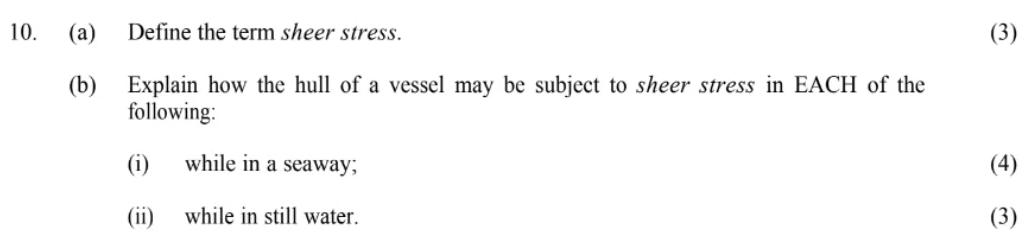
What is the best definition of sheer stress in the context of a vessel's hull?

2 / 5

What type of movement in a seaway is most likely to increase sheer stress on the vessel's hull?

3 / 5

How might a vessel's hull experience sheer stress while floating in still water?

4 / 5

How can a vessel’s hull be subject to sheer stress when it is in a seaway?

5 / 5

Which of the following best describes how sheer stress might be distributed in a vessel at rest in still water?

2

Aux 2 Unit 16 Q3

1 / 7

How is a vessel's hull reinforced to resist pounding?

2 / 7

What structural feature helps to distribute the stress from pounding more evenly across the hull?

3 / 7

Which part of the vessel is most affected by pounding?

4 / 7

What is panting, and how does it relate to a vessel in heavy seas?

5 / 7

What is meant by the term "pounding" as applied to a vessel being driven hard in a seaway?

6 / 7

Why might panting occur at the same time as pounding in heavy seas?

7 / 7

Which of the following methods is commonly used to strengthen a vessel’s hull to resist panting?

2

Aux 2 Unit 16 Q4

1 / 6

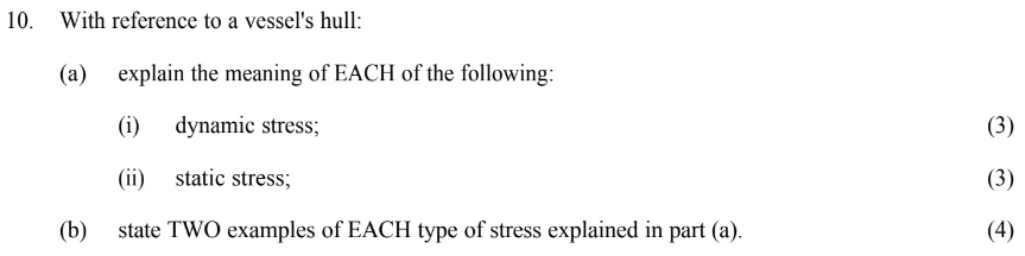
Which of the following is NOT an example of static stress?

2 / 6

Which of the following combinations correctly identifies both a dynamic and static stress on a vessel?


3 / 6

What does the term "dynamic stress" mean when referring to a vessel’s hull?

4 / 6

What is meant by "static stress" in the context of a vessel's hull?

5 / 6

Which of the following is an example of dynamic stress?

6 / 6

Which situation would likely increase static stress on a vessel's hull?

3

Aux 2 Unit 16 Q5

1 / 6

Where is longitudinal stress most likely to be at its maximum on a vessel?

2 / 6

Which of the following structures primarily resists longitudinal stress in a vessel?

3 / 6

In which scenario would a vessel experience significant longitudinal stress?

4 / 6

What is the role of the keel in resisting longitudinal stress?

5 / 6

Which part of the vessel’s structure contributes to both longitudinal strength and watertight integrity?

6 / 6

What is the primary cause of longitudinal stress in a vessel’s hull?

2

Aux 2 Unit 16 Q6

1 / 7

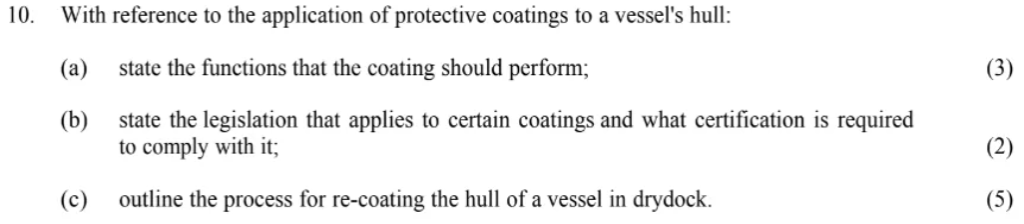
Why is it important to check humidity and temperature before applying the coating?

2 / 7

What is the first step in the process of re-coating a vessel’s hull in drydock?

3 / 7

Which of the following is NOT a function of a protective coating on a vessel’s hull?

4 / 7

What are the main functions that a protective coating should perform on a vessel’s hull?

5 / 7

What legislation applies to the use of certain protective coatings on a vessel’s hull?

6 / 7

What certification is required for compliance with regulations on protective coatings?

7 / 7

Which of the following is a critical step in the re-coating process of a vessel’s hull?

1

Aux 2 Unit 16 Q7

1 / 6

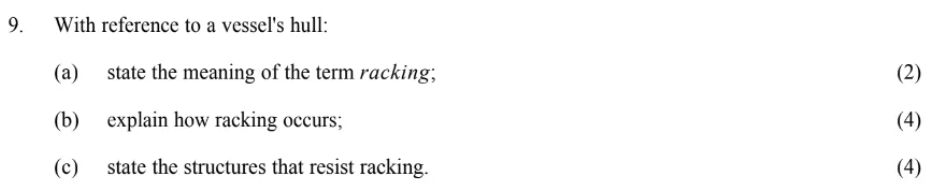
Which structures in a vessel help resist racking?

2 / 6

How does racking occur in a vessel’s hull?

3 / 6

Which of the following conditions is most likely to increase the occurrence of racking?

4 / 6

What is the meaning of the term "racking" as it applies to a vessel’s hull?

5 / 6

Which additional structure complements transverse bulkheads to enhance resistance to racking?

6 / 6

What is the role of transverse bulkheads in preventing racking?

0

Aux 2 Unit 16 Q8

1 / 5

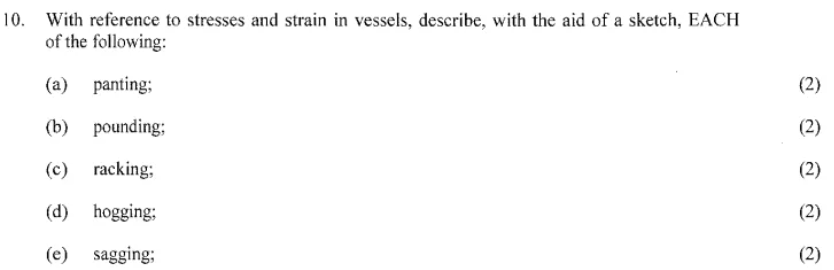
What does "pounding" refer to when applied to a vessel in rough seas?

2 / 5

What is meant by "panting" in the context of a vessel’s hull?

3 / 5

Which of the following best describes "racking" in a vessel?

4 / 5

What does "sagging" mean when referring to the hull of a vessel?

5 / 5

What is "hogging" in the context of ship stresses?

2

Aux 2 Unit 16 Q9

1 / 6

Which of the following is NOT an effect of severe vibration on a vessel?

2 / 6

What is one method to reduce vibration caused by machinery on a vessel?

3 / 6

What is one possible effect of excessive vibration on a vessel?

4 / 6

How can propeller cavitation be reduced to lower vibration levels on a vessel?

5 / 6

What is one common cause of vibration in a vessel?

6 / 6

Which of the following can contribute to vibration due to hydrodynamic forces?
