



Aux 2 Unit 5 3 Phase induction motor Quiz

8

Aux 2 Unit 5 Q1

1 / 7

What is the main disadvantage of reducing the voltage while keeping frequency constant?

2 / 7

Which of the following best describes the result of varying both voltage and frequency in a 3-phase AC induction motor?

3 / 7

What is the benefit of maintaining a constant V/f ratio when controlling motor speed?

4 / 7

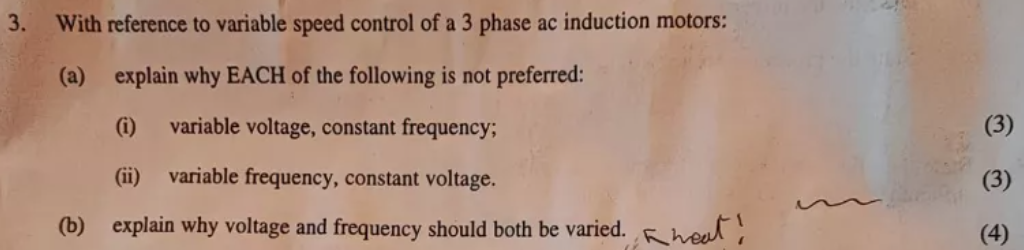
Why is variable voltage, constant frequency control not preferred for speed control in 3-phase AC induction motors?

5 / 7

Why should both voltage and frequency be varied together for effective speed control of a 3-phase AC induction motor?

6 / 7

What happens if frequency is increased while maintaining a constant voltage?

7 / 7

Why is variable frequency, constant voltage control not preferred for speed control in 3-phase AC induction motors?

7

Aux 2 Unit 5 Q2

1 / 7

Which of the following is an advantage of using a solid-state (inverter) starter over conventional starting methods?

2 / 7

What is a disadvantage of using a solid-state (inverter) starter compared to conventional starters?

3 / 7

What advantage does a solid-state (inverter) starter offer for precise motor control?

4 / 7

Which of the following is true about solid-state starters compared to direct-on-line (DOL) starters?

5 / 7

How does an inverter starter affect the inrush current during the starting phase of a motor?

6 / 7

What benefit does a controlled voltage and frequency ramp-up provide during motor startup?

7 / 7

What is the primary characteristic of the starting process when using a solid-state (inverter) starter for a 3-phase induction motor?

6

Aux 2 Unit 5 Q3

1 / 9

How does a VFD change the speed of a three-phase motor?

2 / 9

What role does the rectifier play in a VFD?

3 / 9

Which of the following is a potential drawback of using a VFD with a three-phase motor?

4 / 9

What must be considered when installing a VFD to prevent motor damage?

5 / 9

What is a key advantage of using a VFD for motor speed control?

6 / 9

What is the primary function of a variable frequency drive (VFD) when used with a three-phase motor?

7 / 9

In which of the following applications would a VFD be most beneficial?

8 / 9

How does a VFD improve energy efficiency in motor operations?

9 / 9

Which of the following is NOT a primary component of a variable frequency drive?

6

Aux 2 Unit 5 Q4

1 / 8

What is the primary function of Pulse Width Modulation (PWM) in AC induction motor speed control?

2 / 8

In which scenario would PWM be most advantageous for motor control?

3 / 8

How does PWM achieve speed control in an AC induction motor?

4 / 8

How does changing the duty cycle affect the motor’s performance?

5 / 8

What is one potential drawback of using PWM for motor control?

6 / 8

What effect does PWM have on the waveform supplied to the motor?

7 / 8

What is the “duty cycle” in the context of PWM?

8 / 8

Which of the following is a key benefit of using PWM for speed control in AC induction motors?

5

Aux 2 Unit 5 Q5

1 / 7

Why does the output voltage of an AC generator drop momentarily when a large load is applied?

2 / 7

What happens to the output voltage of an AC generator as it transitions from the initial response to a steady state after a large load application?

3 / 7

What happens if the excitation system fails to respond appropriately during a sudden load increase?

4 / 7

What happens to the output voltage of an AC generator immediately after a sudden large load is applied?

5 / 7

What role does the automatic voltage regulator (AVR) play in an AC generator during sudden load changes?

6 / 7

What adjustment does an AC generator make to return to steady-state voltage after a sudden large load application?

7 / 7

How does an AC generator maintain steady-state voltage under varying load conditions?