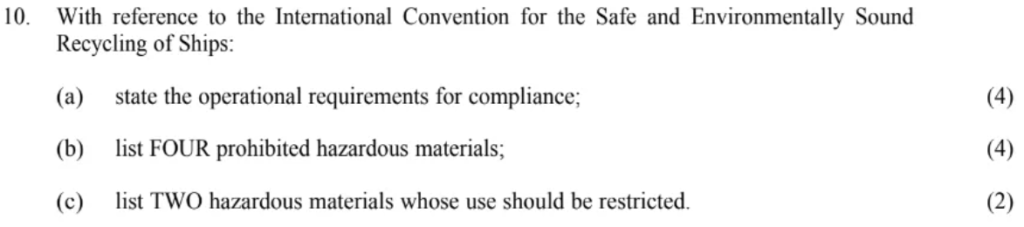
- With reference to the International Convention for the Safe and Environmentally Sound Recycling of Ships:
(a) state the operational requirements for compliance;(4)
(b) list FOUR prohibited hazardous materials;(4)
(c) list TWO hazardous materials whose use should be restricted.(2)
International Convention for the Safe and Environmentally Sound Recycling of Ships (Hong Kong Convention, 2009):
(a) Operational Requirements for Compliance (4 marks)
To comply with the Convention, both ships and recycling facilities must meet specific operational requirements designed to ensure safe and environmentally sound ship recycling:
- Inventory of Hazardous Materials (IHM)
- Every ship of 500 GT and above must maintain an Inventory of Hazardous Materials, identifying the location, type, and quantity of hazardous substances on board.
- The IHM must be kept up to date throughout the vessel’s operational life and verified by the flag administration or recognised organisation.
- International Certificates
- Ships must carry a valid International Certificate on Inventory of Hazardous Materials (ICIHM) or, prior to recycling, an International Ready for Recycling Certificate issued by the flag State.
- Authorised Recycling Facility
- Vessels may only be sent to approved ship recycling facilities that operate under a Ship Recycling Facility Plan meeting Convention standards for worker safety, environmental protection, and waste management.
- Ship Recycling Plan (SRP)
- Before recycling begins, the facility must prepare a Ship-Specific Recycling Plan detailing how the ship will be dismantled, taking into account its structure, equipment, and IHM.
(1 mark per operational requirement = 4 marks)
(b) FOUR Prohibited Hazardous Materials (4 marks)
The Convention prohibits or eliminates the use of the following hazardous materials on new or existing ships (where practicable):
- Asbestos – causes respiratory diseases and cancer when fibres are inhaled.
- Ozone-depleting substances – e.g. CFCs, halons, and other refrigerants harmful to the ozone layer.
- Polychlorinated biphenyls (PCBs) – found in electrical equipment and paints; toxic and persistent in the environment.
- Organotin compounds (including tributyltin-TBT) – used in antifouling paints; highly toxic to marine life.
(1 mark per correctly named prohibited material = 4 marks)
(c) TWO Hazardous Materials Whose Use Should Be Restricted (2 marks)
The use of the following materials is restricted and controlled, not completely prohibited:
- Cadmium and cadmium-based compounds – restricted due to toxicity and potential environmental contamination.
- Hexavalent chromium compounds (chromates) – restricted because of their carcinogenic and corrosive properties.
(1 mark per restricted substance = 2 marks)