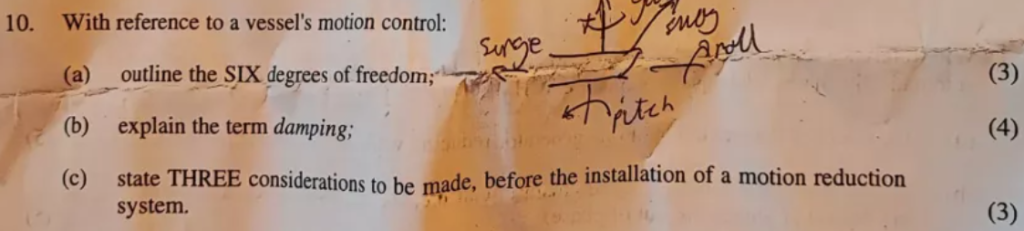
- With reference to a vessel’s motion control:
(a) outline the SIX degrees of freedom;
(b) explain the term damping;(4)
(c) state THREE considerations to be made, before the installation of a motion reduction system.(3)
(a) The Six Degrees of Freedom (6 marks)
A vessel moving freely in the sea has six degrees of freedom — three linear (translational) and three angular (rotational) motions:
| Type of Motion | Axis / Direction | Description |
|---|---|---|
| 1. Surge | Longitudinal (fore and aft) | Forward and backward motion of the vessel along its length due to propeller thrust or wave action. |
| 2. Sway | Transverse (port and starboard) | Side-to-side motion caused by beam seas or manoeuvring forces. |
| 3. Heave | Vertical (up and down) | Vertical motion of the whole vessel due to passing waves. |
| 4. Roll | Longitudinal axis | Side-to-side tilting of the vessel about its length (heel angle variation). |
| 5. Pitch | Transverse axis | Up-and-down tilting of the bow and stern about the vessel’s width. |
| 6. Yaw | Vertical axis | Turning or deviation of the vessel’s heading (swinging about a vertical axis). |
(1 mark per degree of freedom = 6 marks)
(b) Meaning of the Term Damping (4 marks)
- Damping is the process by which vibrational or oscillatory motion is reduced through the absorption or dissipation of energy.
- In a ship, it refers to the reduction in amplitude of motions such as rolling, pitching, or heaving caused by resistive forces.
- Damping may occur naturally due to hull form, bilge keels, water friction, and internal fluid motion, or it may be artificially introduced through stabilizers, fins, or active tank systems.
- Effective damping improves crew comfort, safety, and operational efficiency by limiting excessive motions.
(Definition + mechanism + sources + purpose = 4 marks)
(c) Considerations Before Installing a Motion Reduction System (3 marks)
Before fitting a stabilizing or motion control system (such as fins or anti-roll tanks), the following factors should be evaluated:
- Type and operating profile of the vessel
- For example, yachts, passenger ships, and research vessels have different motion-control requirements.
- Space, weight, and power availability
- Systems such as fin stabilizers or active tanks require hydraulic power, control units, and space for installation.
- Maintenance and operational complexity
- Consider maintenance access, cost, and crew training for safe and efficient operation of the system.
(1 mark per valid consideration = 3 marks)