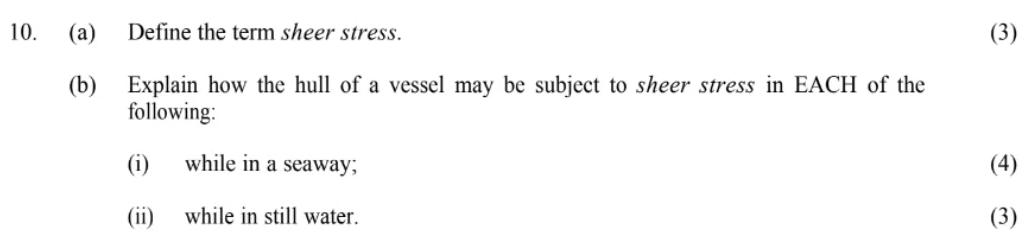
- (a) Define the term sheer stress.(3)
(b) Explain how the hull of a vessel may be subject to sheer stress in EACH of the following:
(i) while in a seaway;(4)
(ii) while in still water.(3)
(a) Definition of Shear Stress (3 marks)
- Shear stress is the internal stress induced in a material when two parallel but opposing forces act tangentially on adjacent layers of that material.
- It is the force per unit area that tends to cause one layer to slide over another.
- Mathematically:
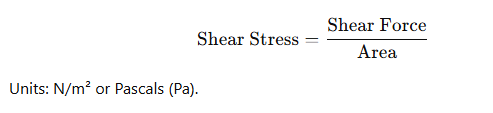
(Full, clear definition with formula and units = 3 marks)
(b) How the Hull of a Vessel May Be Subject to Shear Stress
(i) While in a seaway (4 marks)
- When the vessel is on a wave crest, the midship region is lifted by buoyancy, while the ends are unsupported, causing hogging.
- Conversely, when the vessel is in a wave trough, the bow and stern are supported, and the middle sags downward, causing sagging.
- In both cases, unequal longitudinal bending moments occur along the hull.
- This results in shear forces between adjacent structural sections (e.g., between frames, decks, and keel) as the hull alternately bends and flexes.
These internal forces create shear stresses, particularly at bulkheads and deck connections.
(Explanation of hogging, sagging, and resulting internal shear = 4 marks)
(ii) While in still water (3 marks)
- Even in still water, the distribution of buoyancy and weight along the vessel’s length is not uniform.
- The weight curve (due to cargo, machinery, etc.) and the buoyancy curve (due to hull shape) do not coincide.
- The difference between these curves at any point causes a vertical shear force along the hull girder.
- These forces result in shear stress mainly at the neutral axis of the hull, especially near the ends of the midship region.
(Explanation of uneven weight and buoyancy leading to vertical shear = 3 marks)