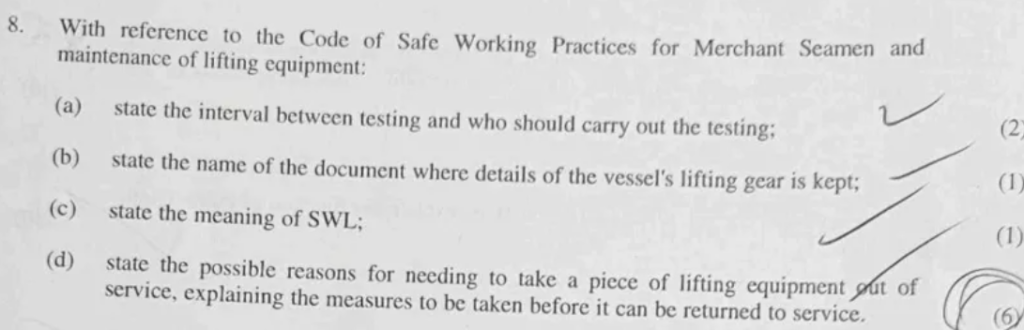
With reference to the Code of Safe Working Practices for Merchant Seamen and maintenance of lifting equipment: (a) state the interval between testing and who should carry out the testing;(2) (b) state the name of the document where details of the vessel’s lifting gear is kept;(1) (c) state the meaning of SWL;(1) (d) state the possible reasons for needing to take a piece of lifting equipment out of service, explaining the measures to be taken before it can be returned to service.(6)
(a) Interval between testing and who should carry out the testing (2 marks)
All lifting appliances and loose lifting gear must be thoroughly examined and tested at least once every 12 months.
The testing and certification must be carried out by a competent person, such as a classification society surveyor or an authorised testing organisation, in accordance with the Code of Safe Working Practices for Merchant Seamen and statutory requirements (e.g. LOLER / Merchant Shipping regulations).
(b) Name of the document where details of the vessel’s lifting gear are kept (1 mark)
The details are recorded in the Register of Lifting Appliances and Loose Gear (Form GC/1 or MGN 332-equivalent).
(c) Meaning of SWL (1 mark)
SWL stands for Safe Working Load — the maximum load that a piece of lifting equipment may safely lift under normal operating conditions.
(d) Reasons for taking a piece of lifting equipment out of service, and measures before returning to service (6 marks)
Possible Reasons:
Visible damage or deformation — e.g. bent hooks, cracked welds, worn sheaves, or frayed wire ropes.
Corrosion or excessive wear that may weaken the equipment or compromise safety.
Failed inspection or test results, such as elongation, permanent stretch, or failure to meet load test standards.
Unknown history or missing certification, where documentation or test records are incomplete.
Exposure to shock loading or overloading, which may have caused hidden structural damage.
Measures to be taken before returning to service:
The equipment must be immediately tagged “OUT OF SERVICE” and isolated from use.
A competent person must inspect, test, and certify the item again to ensure it is safe for use.
Any repairs must be carried out by qualified personnel using approved materials and methods.
The Register of Lifting Appliances and Loose Gear must be updated to include new test certificates and details of repairs.
Only after satisfactory testing and record-keeping can the equipment be returned to operational service.