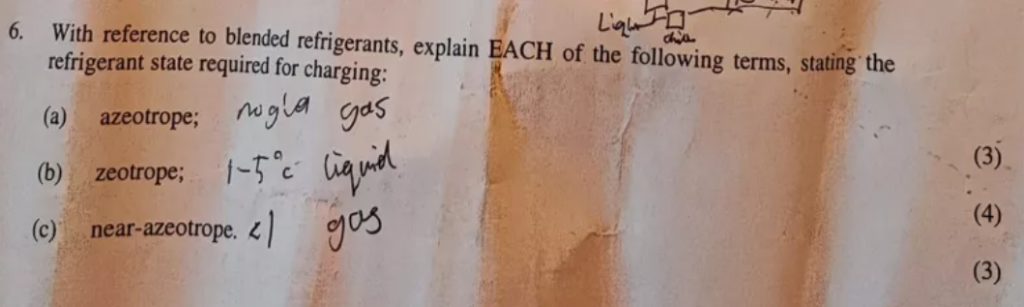
With reference to blended refrigerants, explain EACH of the following terms, stating the refrigerant state required for charging:
(a) azeotrope;
(b) zeotrope;
(c) near-azeotrope.
(a) Azeotrope
- Definition:
An azeotropic refrigerant blend behaves like a single substance. Its constituents boil and condense at the same temperature at a given pressure. - Characteristics:
- No temperature glide during evaporation/condensation.
- Does not separate into components during phase change.
- Properties remain constant, making it easy to handle like a pure refrigerant.
- Examples: R-502, R-507.
- Charging state: May be charged in either liquid or vapour form, since its composition remains uniform.
(b) Zeotrope
- Definition:
A zeotropic refrigerant blend consists of components with different boiling points. It undergoes fractionation (change in composition) if charged or leaked in vapour phase. - Characteristics:
- Exhibits a temperature glide (difference between bubble point and dew point during phase change).
- Performance can shift if the composition is altered.
- Examples: R-407C, R-404A.
- Charging state: Must be charged in liquid form, to ensure the correct blend ratio is maintained.
(c) Near-azeotrope
- Definition:
A near-azeotropic blend behaves almost like an azeotrope, but has a very small temperature glide (typically < 1 K). - Characteristics:
- Fractionation is possible but minimal.
- Often treated practically as azeotropes in service conditions.
- Examples: R-410A.
- Charging state: Should be charged in liquid form, to avoid slight fractionation and ensure mixture consistency.