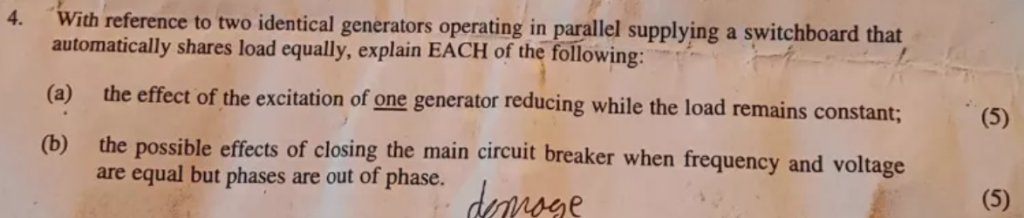
With reference to two identical generators operating in parallel supplying a switchboard that automatically shares load equally, explain EACH of the following: (a) the effect of the excitation of one generator reducing while the load remains constant;(5) (b) the possible effects of closing the main circuit breaker when frequency and voltage are equal but phases are out of phase. (5)
(a) Effect of the excitation of one generator reducing while load remains constant (5 marks)
Excitation controls reactive power (kVAr) and voltage output.
If excitation of one generator is reduced while total load remains constant:
That generator will absorb reactive power (lagging power factor) instead of supplying it.
The other generator will automatically supply more kVAr to maintain busbar voltage.
True power (kW) sharing remains unchanged because excitation does not affect governor settings.
The under-excited generator may draw magnetising current from the other, operating at a leading power factor.
If excitation is reduced too far, it may cause loss of synchronism, overheating of the stator end windings, or pole slipping.
(b) Effects of closing the main circuit breaker when frequency and voltage are equal but phases are out of phase (5 marks)
If the breaker is closed out of phase, even with equal voltage and frequency:
Severe synchronising torque is created, causing mechanical shock on the prime mover and shaft.
Large circulating currents flow between the two machines due to phase displacement.
This can result in breaker contact damage due to high inrush currents.
Electrical stresses may overheat windings and cause loss of insulation life.
In extreme cases, it can cause blackout, trip of protective devices, or even damage to both generators and switchboard busbars.