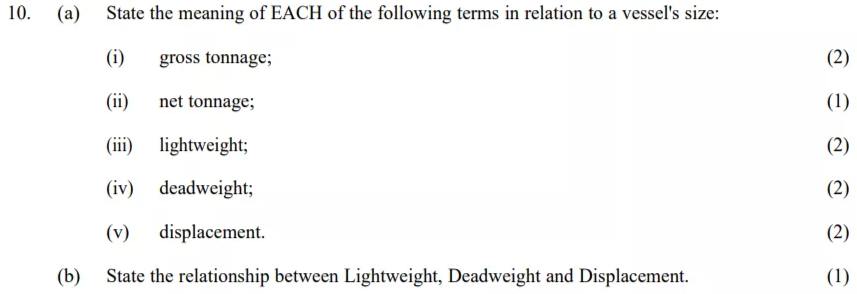
- a State the meaning of EACH of the following terms in relation to a vessel’s size:
(i) gross tonnage;(2)
(ii) net tonnage;(1)
(iii) lightweight;(2)
(iv) deadweight;(2)
(v) displacement.(2)
(b) State the relationship between Lightweight, Deadweight and Displacement.(1)
(a) Definitions
(i) Gross Tonnage (GT) (2 marks)
- A measure of the internal volume of all enclosed spaces of a ship, calculated using IMO’s tonnage measurement rules.
- It is a dimensionless index (not a weight) and is used mainly for regulatory, port dues, and safety rules.
(ii) Net Tonnage (NT) (1 mark)
- A measure of the usable volume of the vessel available for carrying cargo and passengers.
- Derived from gross tonnage after deducting spaces not used for revenue (e.g. crew spaces, machinery spaces).
(iii) Lightweight (2 marks)
- The actual weight of the vessel itself without cargo, fuel, stores, passengers, or crew.
- Includes the hull, machinery, permanent equipment, and fittings.
(iv) Deadweight (DWT) (2 marks)
- The difference between the vessel’s displacement at loaded draught and at lightweight.
- Represents the carrying capacity: cargo, bunkers, fresh water, ballast, stores, passengers, and crew.
(v) Displacement (2 marks)
- The total weight of the volume of water displaced by the ship’s hull.
- Equal to the actual weight of the ship at any condition of loading (Archimedes’ principle).
(b) Relationship (1 mark)
Displacement=Lightweight+Deadweight\text{Displacement} = \text{Lightweight} + \text{Deadweight}Displacement=Lightweight+Deadweight