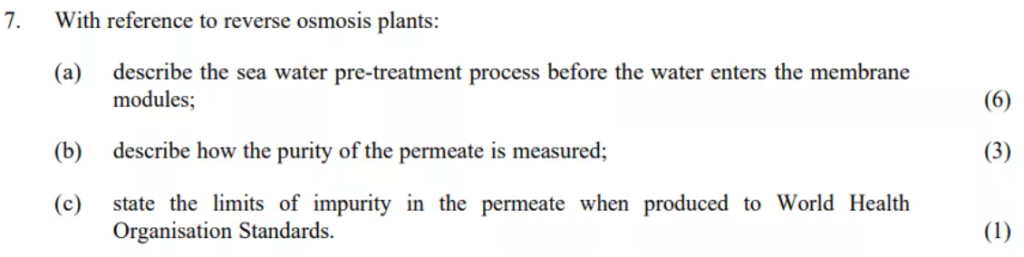
- With reference to reverse osmosis plants:
(a) describe the sea water pre-treatment process before the water enters the membrane modules;(6)
(b) describe how the purity of the permeate is measured;(3)
(c) state the limits of impurity in the permeate when produced to World Health Organisation Standards.
(a) Seawater pre-treatment process before entering the membrane modules (6 marks)
Before seawater passes into the reverse osmosis (RO) membranes, it must be treated to protect the membranes and ensure efficient operation:
- Screening – Coarse filters or strainers remove large debris such as seaweed, shells, or sand.
- Coagulation/flocculation – Chemicals (e.g., ferric salts or polyelectrolytes) may be added to cause fine suspended solids to clump together for easier removal.
- Filtration – Multi-media filters (sand, anthracite, or cartridge filters) remove fine suspended solids.
- Dechlorination – If chlorination was used for biofouling control, sodium bisulphite is added to neutralise chlorine, as chlorine would damage the membranes.
- pH adjustment / antiscalant dosing – Acids or antiscalant chemicals are added to reduce scaling from salts (e.g., calcium carbonate, sulphates).
- Final cartridge filtration – A fine micron filter (typically 5 µm) removes any last traces of suspended matter before the RO membranes.
(b) Measuring the purity of the permeate (3 marks)
- Conductivity or Total Dissolved Solids (TDS) meters measure the electrical conductivity of the permeate, which is directly related to the salt concentration.
- Salt rejection rate is calculated by comparing feedwater and permeate conductivity.
- Continuous monitoring systems ensure the water meets potable standards before storage.
(c) Limits of impurities in the permeate under WHO Standards (1 mark each = 3 marks)
According to World Health Organisation (WHO) guidelines for potable water:
- Total Dissolved Solids (TDS): Should be less than 500 mg/L (acceptable up to 1000 mg/L, but <500 mg/L preferred for taste and health).
- Chloride content: Typically should not exceed 250 mg/L.
- Turbidity: Should be less than 1 NTU (Nephelometric Turbidity Unit).